Event Recorders or Train Data Recorders
EKE-Trainnet® Event Recorders, also known as train data recorders, capture analogue and digital signals with precision. They can be configured to record only necessary signals, optimising data storage and costs. Designed to support SIL 2 development, they ensure reliability and compliance with safety standards. Redundancy can be achieved with two sets of modules or separate event recorders, including two independent recorders in the same rack. Additional interfaces can be added as needed.
A Choice of Event Recorders
A range of train data recorders designed to capture and store critical onboard operational data, supporting monitoring, diagnostics, incident investigation and compliance requirements.
Non-Rugged Event
Recorder
The EKE-Trainnet® Non-Rugged Event Recorder is a train data recorder built using standard input/output modules. It can be configured to record safety-critical information such as train speed, train position and brake temperature.
The recorder can also capture video streams from onboard digital video recorders or directly from cameras.
Additional interfaces can be easily added.
Rugged Event
Recorder
The EKE-Trainnet® Rugged Event Recorder incorporates the EKE-Trainnet® Rugged Memory Module. This crash-protected train data recorder safeguards recorded information against fire, magnetic fields, liquids and mechanical impacts.
The memory board is embedded within a protected fire-insulation block and enclosed in a hermetically sealed steel housing.
Additional interfaces can be easily added.
Juridical Recording
Unit
The EKE-Trainnet® Juridical Recording Unit (JRU) is a train event recorder that complies with ERTMS/ETCS requirements.
Data can be recorded from ETCS via the EVC (European Vital Computer) and from national train protection systems through STM (Specific Transmission Module) interfaces.
It includes all the capabilities of the EKE-Trainnet® Rugged Event Recorder.
Technical Specifications
Minimum rack size:
87 mm × 229 mm × 215 mm
Minimum weight:
1.21 kg + module weight
Temperature Range (operational):
-40 °C…+70 °C
Input voltage:
24–110 V DC
Rugged Memory Module (RMM):
RMM 84TE only
Connectivity:
1 Ethernet M12
3 x RS-485
Power supply cabling:
Front (ER 44TE, ER 84TE, RMM 84TE)
Back (ER Flat 3U x 12TE, ER 20TE, ER Flat 6U x 12TE)
Options for side mounting:
ER 44TE, ER 84TE, RMM 84TE
Optional bus & I/O interfaces:
ER Flat 3U x 12TE:
No free slot
ER 20TE:
2 free slots for: MVB, CAN, SIU and/or AIM*, HSA, DIO*, DRO*, AOM*, PTI*
*max of 1 module
ER Flat 6U x 12TE:
3 free slots for: MVB*, CAN*, SIU* and/or AIM, HSA*, DIO, DRO, AOM, PTI
*max of 1 module
ER 44TE:
7 free slots for: MVB, CAN, SIU and/or AIM*, HSA, DIO*, DRO*, AOM*, PTI*
*max of 5 modules
ER 84TE:
17 free slots for: MVB, CAN, SIU
and/or AIM*, HSA, DIO*, DRO*, AOM*, PTI*
*max of 15 modules (others max of 9 modules)
RMM 84TE:
10 free slots for: MVB, CAN, SIU
and/or AIM*, HSA, DIO*, DRO*, AOM*, PTI*
*max of 6 modules
The products, specifications, features and design are subject to change without notice.
Key Features
High-performance processing with support for SIL 2 capable functions
Next‑generation CPUs provide increased processing headroom for multi‑stream data capture, with support for SIL 2 capable functions and dual‑homed networking.
Configurable, continuous data capture
Continuous on‑time data recording ensures complete and reliable data capture, with configurable logging intervals and event‑based triggers to record the required level of detail.
Crash‑protected rugged memory
A crash‑proof rugged memory module protects data in a fire‑insulated, reinforced structure, keeping it intact
under impact, fire, liquids, and magnetic exposure.
Fast data access and analysis
The TIP Tool enables fast download and analysis of Event Recorder data, with clear visualisation and tools to identify, compare, and export data for diagnostics.
Smart cyclic storage
Cyclic data storage automatically overwrites older records, while event‑triggered locking preserves critical data, with flexible memory capacity.
Cybersecurity for Event Recorders and Train Data Recorders
The Event Recorders derive their cybersecurity strength from the next‑generation CPUs. These CPUs provide a secure foundation that aligns with IEC 62443‑4‑2 requirements to SL2 and the expectations of the EU Cyber Resilience Act. The platform gives the Event Recorder stronger protection for data handling, communication interfaces and overall system integrity.
The hardened execution environment and long‑term support help ensure that operational and safety‑critical information remains trustworthy. These cybersecurity measures work alongside the unit’s SIL 2 capable architecture, supporting safe operation without adding
unnecessary complexity to system integration.
Software
Train Inspection Program
The Train Inspection Program enables the transfer and analysis of data from EKE-Trainnet® Event Recorders and train data recorders, enabling real-time monitoring, customisable visualisation, and reporting.
Versatile data displays, including graphical, numerical, and signal views, are offered by the Train Inspection Program, tailored to your needs. Quickly locate key points in data logs, customise views, and archive Event Recorder data for later analysis.
The Train Inspection Program can display multiple data files simultaneously, aiding in comparisons and trend identification, ensuring you have the insights to improve train operations and safety.
An online monitoring feature allows real-time tracking of selected signals in the car without interfering with the Event Recorder’s normal operations. Under all conditions, the Train Inspection Program ensures that your data is kept confidential with the highest levels of integrity.
The data can also be exported to a third-party application in an open format, such as a CSV file.
Build Your Own Applications
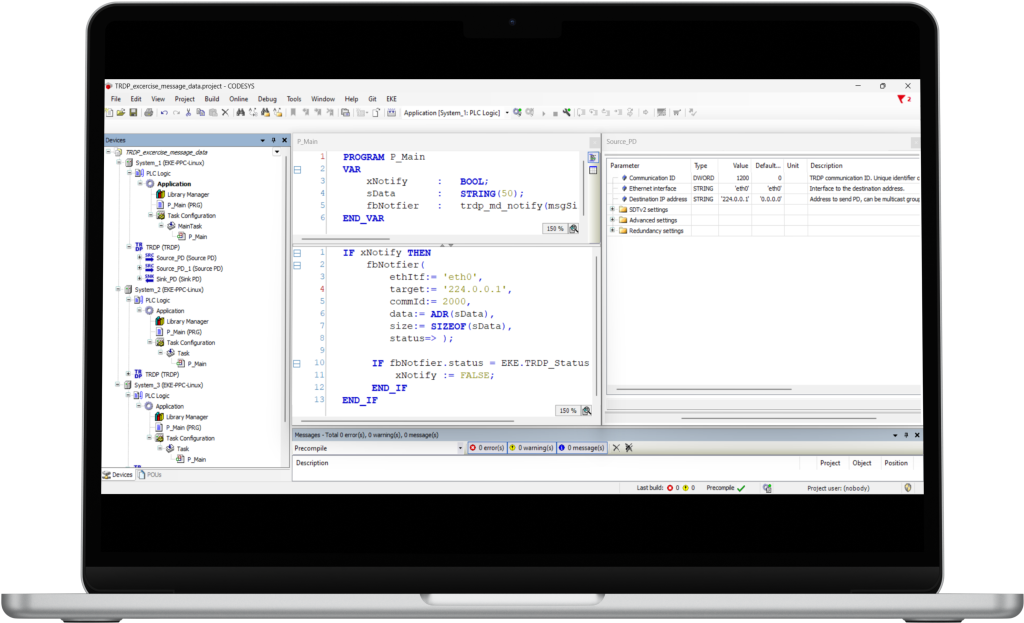
EKE-Trainnet® Event Recorders are built on an open-source Linux platform powered by CODESYS®. It allows you to develop custom applications.
If you prefer to develop in-house. EKE-Electronics provides training, tools, and guidance to support your development efforts. Alternatively, EKE-Electronics has expertise to develop fully or partially software on your behalf.
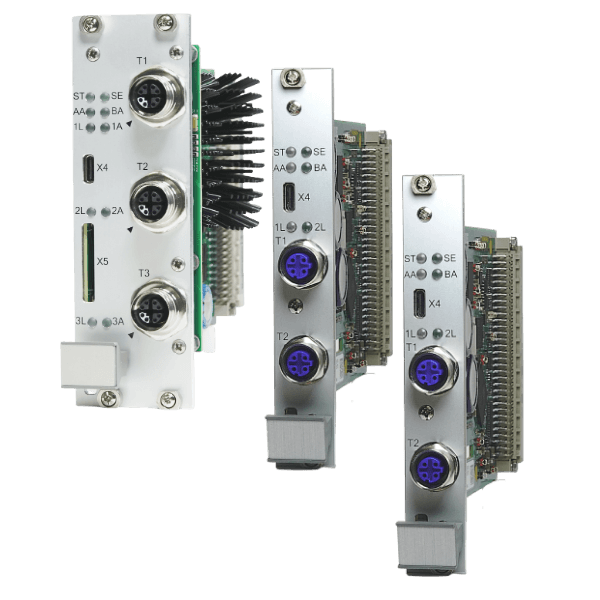
Build Event Recorders using the following modules
The following modules are required to create an event recorder. Click on an image to explore related content.
Modular Concept
All our EKE-Trainnet® products are modular, enabling you to precisely select the modules you require. Modules can be combined for a very flexible and versatile solution. This means that the Event Recorder or Train Data Recorder can be integrated with other systems into a single rack, optimising space and efficiency.
Below is an example of an Event Recorder made up of a selection of common modules. Hover over each area to view a brief description or click to access the full module page.
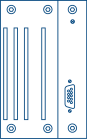
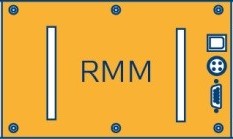
Rugged Memory Module
Rugged memory module designed to fulfil the British (GM/RT2472-1.2002) and European (EEIG 97E461-3.1998) crashworthiness as well as the IEEE (1482.-1.1999) standards.
With Ethernet port and RS-485 port. Front-panel imprints are available upon request.
CPU with Serial Links (CPS)
A central processing unit providing serial communication interfaces.
Digital Input Output Module (DIO)
Receives digital signals through its input channels and delivers them to the train computer’s Central Processing Unit (CPU) module for processing.
Choose the appropriate input output module to capture the signals you need.
Analogue Input Module (AIM)
Converts analogue signals and makes them available to the train computer’s CPU module.
Choose the appropriate input output module to capture the signals you need.
Power Supply Unit for VME (PSV)
Provides power for the system.
Power Input Unit (PIU)
Used to pass train battery voltage to the EKE-Trainnet® Power Supply Unit for VME (PSV) module
Why Choose EKE-Electronics for an Event Recorder?
EKE-Trainnet® Event Recorders capture signals, recording both analogue and digital inputs with precision. These train data recorders can be customised to record only the necessary signals, reducing unnecessary data storage and associated costs. Additionally, they are designed to support SIL 2 development, ensuring reliability and compliance with safety standards.
Choose on the signals you need
With a modular design, EKE-Trainnet® Event Recorders provide the flexibility to select and record only the signals you need to streamline data management and reduce costs associated with unnecessary data capture and storage.
Open data
policy
EKE-Electronics maintains an open data policy, facilitating effortless data retrieval via Ethernet, enabling seamless import and export into other systems.
GNSS & dual homing available
A GNSS (Global Navigation Satellite System) receiver can be integrated into the Event Recorder. Ethernet dual homing with M12 connectors is also available.
Relevant News & Blogs
- Blog post
- Blog post
Frequently Asked Questions
What is an Event Recorder?
An Event Recorder, often referred to as a “train black box” is an onboard data recorder for collecting and storing a wide array of operational data related to the train’s performance and activities. The primary purpose of the event recorder is to capture and store critical information that can be used for accident investigation, safety analysis, and operational reviews.
What is Train Data Recorder?
A train data recorder is a system that continuously records operational, diagnostic and safety-related information from onboard train systems. Data such as speed, braking activity, door status, driver actions and system events can be stored for fault analysis, maintenance and incident investigation. Train data recorders are also commonly referred to as event recorders.
What is a Train Black Box?
A train black box is an informal term for an Event Recorder or Train Data Recorder. Like the flight recorders used in aircraft, it captures and stores operational data from the train so that engineers can analyse system behaviour, investigate incidents, and review performance. Although the term “black box” is widely used, the official industry terms are Event Recorder, Train Data Recorder, or Juridical Recording Unit (JRU), depending on the application.
What is a Juridical Recording Unit (JRU)?
A Juridical Recording Unit (JRU) is a specialised type of train data recorder designed to meet specific regulatory and investigation requirements. It records defined operational data and stores it in protected memory so that information remains available for incident investigations and safety reviews. JRUs are commonly associated with ETCS-equipped trains and applications where regulations specify the data that must be recorded.
What is the Difference Between an Event Recorder and a Train Data Recorder?
There is generally no difference. The terms “event recorder” and “train data recorder” are often used interchangeably within the train industry. Both refer to a system that records onboard operational data to support diagnostics, maintenance, incident investigation and regulatory compliance.
What is the Difference Between a Rugged and Non-Rugged Event Recorder?
Both rugged and non-rugged Event Recorders capture and store train operational data. The main difference is how the recorded data is protected.
A non-rugged Event Recorder stores data in standard memory and is suitable for many operational and maintenance applications. A rugged Event Recorder includes a crash-protected memory module designed to protect recorded data from impact, fire, liquids, magnetic fields and other extreme conditions. This protection helps ensure that critical information remains available following a serious incident.
What Data Can a Train Data Recorder Capture?
A train data recorder can capture information from a wide range of onboard systems, including train speed, location, braking systems, traction equipment, door systems, driver controls, signalling interfaces and other analogue or digital inputs. The exact signals recorded can be configured to meet project requirements.
How Long is Data Stored in a Train Data Recorder?
Data retention depends on the configuration, memory capacity and amount of data being recorded. Train Data Recorders typically use cyclic storage, where the oldest information is automatically overwritten when storage limits are reached. Critical data can be protected through event-triggered locking, preventing it from being overwritten. EKE-Trainnet® Event Recorders support flexible memory configurations to match project requirements.
Why is a Train Data Recorder Important?
Train data recorders provide an accurate historical record of train operation. Recorded data can be used to investigate incidents, analyse faults, support preventative maintenance activities and demonstrate compliance with industry requirements.
Can an Event Recorder be Integrated with a TCMS?
Yes. EKE-Trainnet® Event Recorders are built on the same modular platform as the wider TCMS and can be integrated with onboard networks, I/O modules and other train systems. This enables the recorder to capture operational information from multiple subsystems while reducing integration effort and avoiding unnecessary duplication of hardware.
What is the Train Inspection Program or TIP Tool?
A Train Inspection Program (TIP) is a software tool used for the transfer and analysis of data recorded in the EKE-Trainnet® Event Recorder.
Learn more about the EKE-Trainnet® Train Inspection Program.
Do you support 24-110VDC?
We have a range of different power supplies supporting 24-11VDC:
- PSV1133: 24V
- PSV1513: 72V
- PSV2513: 36..52V
- PSV3034: 48..110V
- PSV1018: 110V
- PSR3032: 110V
The key difference between the PSV and PSR is that the PSV provides an 80 ms grace supply following loss of input power.