ASDO: Automatic Selective Door Operation

SIL 2 Pre-Certified | Compatible with Any TCMS | Balise-Free Positioning 

EKE-Electronics’ ASDO is a SIL 2 pre-certified system designed as a generic solution that integrates easily with any Train Control and Management System (TCMS). The system uses odometry and GNSS as standard to deliver balise‑free positioning. It also provides Correct Side Door Enabling to support safe door operations at every station.

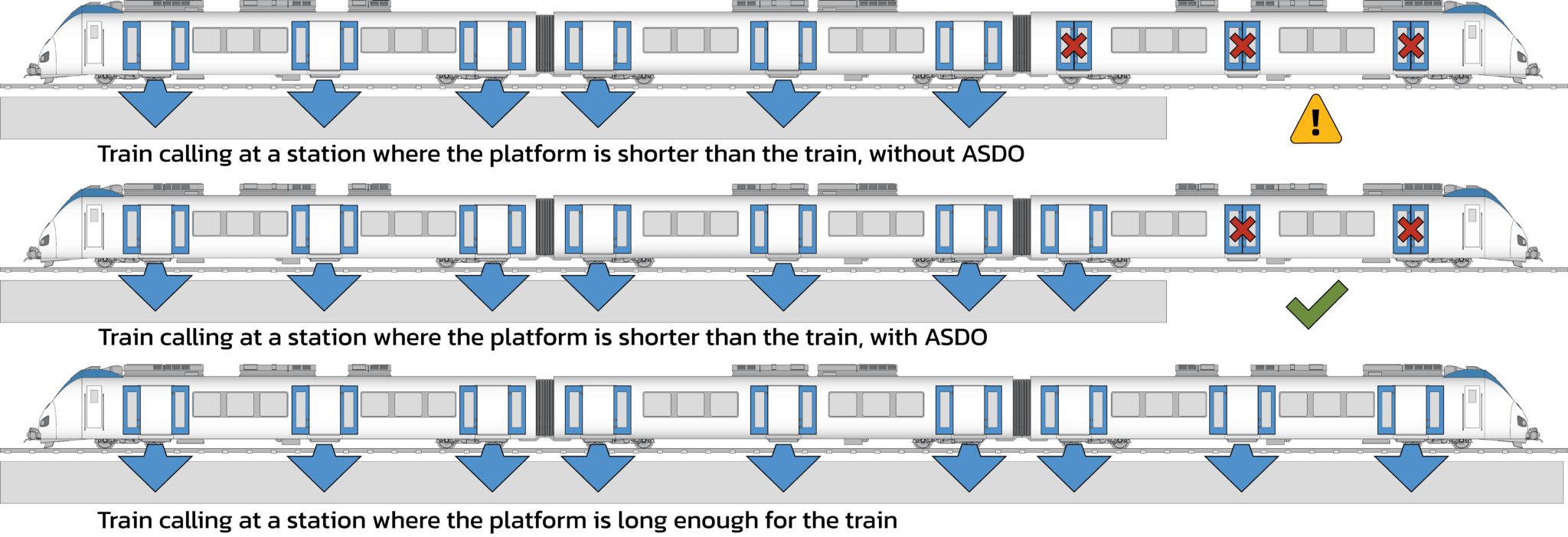
ASDO allows operators to run longer trains on routes with short platforms without changing existing infrastructure. It supports new rolling stock programmes and modernisation projects.

EKE‑Electronics’ ASDO is deployed worldwide and has been proven across extensive daily operations. Optional features include advanced positioning methods such as RFID beacons and ETCS Eurobalises for networks that require added precision or redundancy.

COMPLIANCE:
SIL 2, EN 50126, EN 50716 (previously EN 50128), EN 50129, RIS-2747-RST

What is ASDO?

Automatic Selective Door Operation (ASDO) is a railway safety system that releases only the doors positioned next to a platform. The system reduces the risk of unsafe passenger disembarkation at stations with short or irregular platforms.

ASDO improves operational control because it identifies the exact door locations relative to the platform edge. This improves accuracy compared with older systems that unlock doors by coach or car.

What Makes EKE-Electronics' ASDO Different?

ASDO provides a flexible and reliable approach to Automatic Selective Door Operation. It reduces engineering effort and strengthens operational safety across varied rolling stock. The system supports new fleets and refurbishment projects without major integration work.

Certified Safety and Faster Approval

ASDO arrives with SIL 2 certification. This shortens approval cycles and lowers integration risk. Operators benefit from predictable deployment schedules and reduced project cost.

Balise-Free as Standard

The system uses odometry and GNSS to locate the train. This removes the need for expensive trackside balises and cuts long‑term infrastructure cost. 

Built for Quick Deployment

ASDO fits into any Train Control and Management System. The standardised architecture reduces engineering lead time. This keeps deployment efficient while preserving strong safety performance.

Integrated Correct Side Door Enabling (CSDE)

Correct Side Door Enabling prevents doors opening on the wrong side. This feature adds a clear safety layer for both drivers and passengers. 

Designed for Many Train Configurations

ASDO supports EMUs, DMUs, locomotives, passenger cars, and mixed formations. Its integration model remains consistent across these configurations. 

Suitable for Retrofit and New Build

ASDO fits both new fleets and refurbishment projects. This makes it a practical choice for long‑term asset planning.

Expandable Functionality

Additional features can run on the same platform. These include functions such as Hot Axle Box Detection.

  • This reduces hardware footprint across the vehicle.
  • This also simplifies maintenance planning and long‑term support.

Proven in Daily Operation

ASDO operates on multiple international rail networks around the world. The system delivers stable performance in real-world conditions. Operators benefit from a mature product with a strong service record. and long‑term support.

Why ASDO Matters

  • Enabling Longer Trains on Short Platforms: 
    Deploy longer trains on routes with short platforms without modifying existing infrastructure. Increase capacity and grow revenue while maintaining high safety standards.
  • Safety at Short Platforms: Prevents passengers from stepping onto unsafe areas.
  • Correct Side Door Enabling (CSDE): Activates doors only on the platform side.
  • Reducing Human Error: Automates door selection logic for consistent safety.
  • Operational Efficiency: Eliminates manual door selection errors.
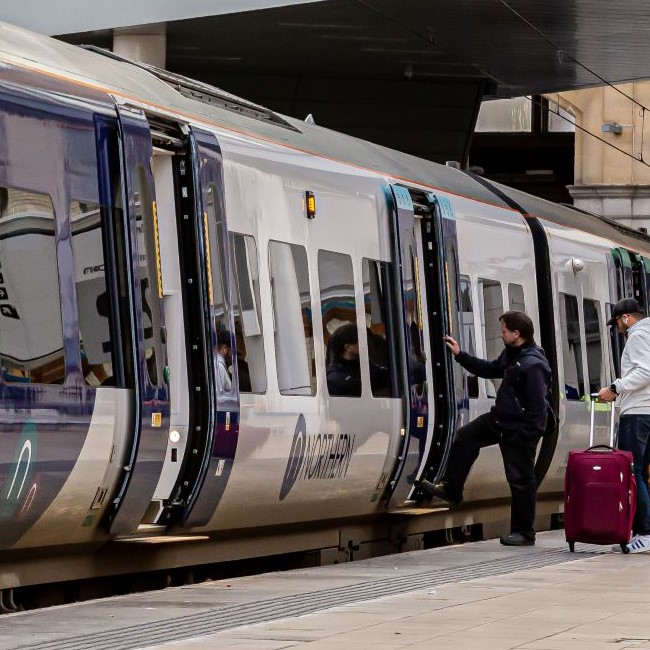
  • Improved Passenger Experience: Reduces inconvenience for passengers when some platform‑aligned doors remain closed.


Core Features

ASDO includes essential safety and operational features designed to ensure reliable performance across diverse rail environments.

SIL 2
Pre-Certified

Pre-certification reduces engineering work, speeds up deployment, and lowers the total cost across the product lifecycle.

Easy
Integration

Integrates easily with any TCMS, reducing integration effort.

Automatic Direction Change

Door and step status is maintained when the train changes direction or during cab switches.

Correct Side Door Enabling (CSDE)

CSDE is part of ASDO and allows only the doors on the correct side to open. It keeps the doors on the wrong side disabled for safety. ASDO provides individual door control through a digital output. This control supports accurate door management on every unit.

Station Database with Version Control

The ASDO Station Database stores station and platform data for building the network. It’s easy to update for route or track changes and includes version control, viewable via the ASDO HMI.

Automatic Train Configuration

The system identifies the train configuration and tracks the number of cars in the formation. It also detects the sequence of those cars to support accurate door control. This information ensures the train aligns correctly with the platform during each stop.

Accurate Identification Of Train’s Location

Our solution combines GNSS satellite data with odometry-based speed and distance inputs. This approach delivers precise dead reckoning and maintains accurate train location during operation. It also supports reliable platform alignment at every stop.
Passenger Information System (PIS) Interface

ASDO can provide next station, platform and door pattern information for the PIS system through the TCMS interface.

Diagnostic Information

The system sends diagnostic information to the Train Control and Management System. It reports sensor status to support quick detection of issues. It also provides fault codes to help teams identify the source of problems. Operational health metrics are included to support proactive maintenance planning.

SIL 2 Compliant ASDO User Interface

The ASDO Human‑Machine Interface provides clear door and station information to the crew. It supports efficient operations and helps staff make informed decisions during each stop. The HMI is designed for strong usability and meets SIL 2 requirements. It also follows ISO 9241 and EN 16186‑3 standards to ensure compliant and reliable performance.

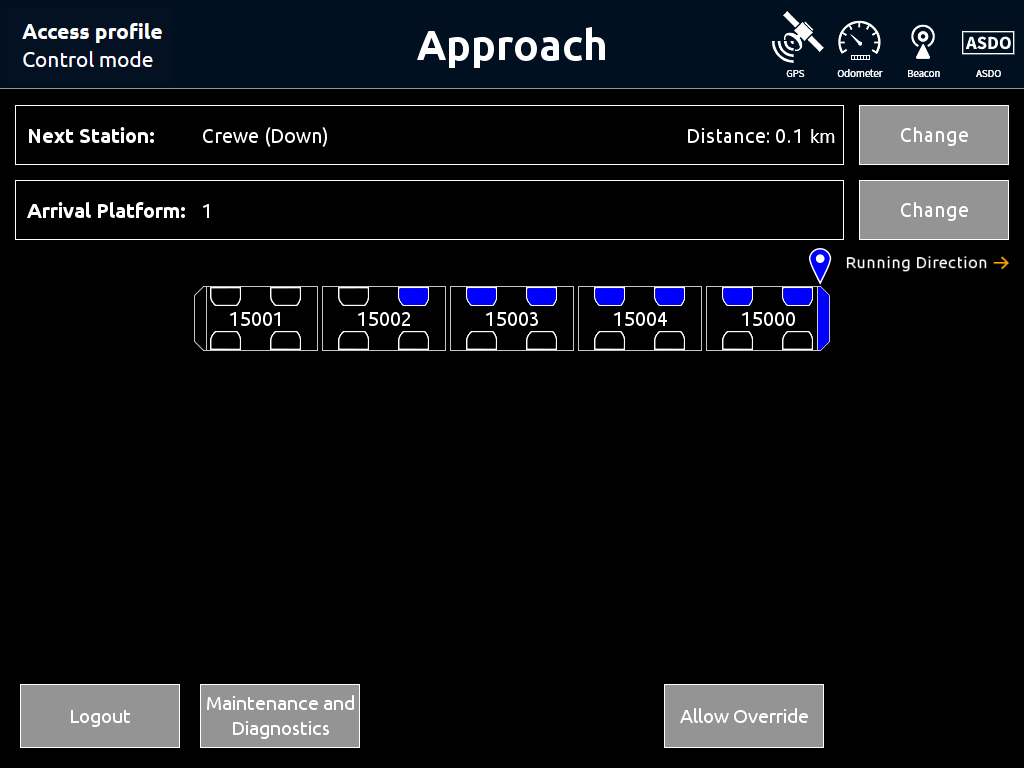
Approach HMI

As the train approaches a station, the display shows the next stop and the assigned arrival platform. If a change is needed, the crew can update this information using the change button.

The system cross-references the train’s determined location with the ASDO Station Database. Safe-to-open doors are highlighted in blue on the screen. A “blue nose” clearly marks the front of the train. If necessary, the crew can override the door configuration from this interface.

Dedicated screens allow technicians to manage maintenance tasks in the depot. These screens let staff configure wheel diameter and check the current ASDO status. They also allow teams to verify installed software versions and run essential troubleshooting steps.

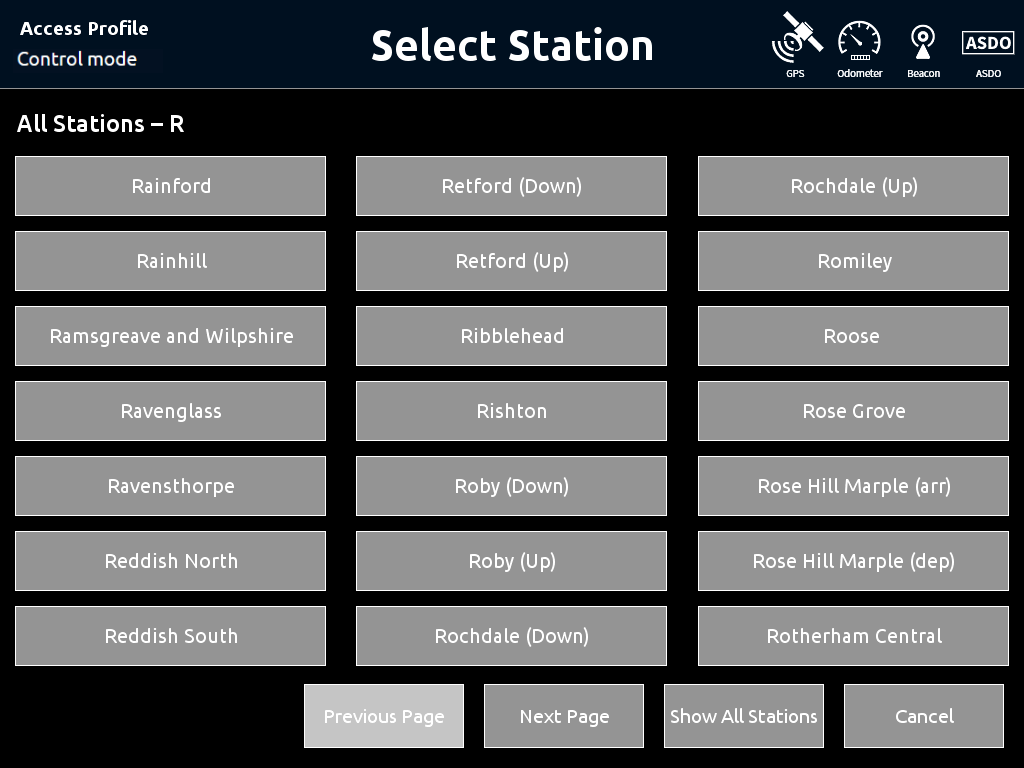
Select Station HMI
If the next station needs to be changed, such as during a diversion, the HMI allows the crew to make adjustments. By clicking the change button, a list of logical next stations based on the train’s current location is displayed. Alternatively, the user can view all stations to access a complete list of network stations.

The ASDO system can connect to non‑EKE display units used by drivers, guards, or maintenance staff. These displays may be shared with other train functions or dedicated to ASDO tasks. 

Communication uses IP over Ethernet with the SDTv2 safe protocol and TRDP. This approach maintains SIL 2 compliance across all supported display platforms.

How does ASDO work?

The ASDO process is easier to understand when you can see it in action. The video walks through each operational step and shows how the system identifies the station, selects the correct doors, and confirms safe operation. 
How does Automatic Selective Door Operation (ASDO) Work?

Build ASDO using the following modules

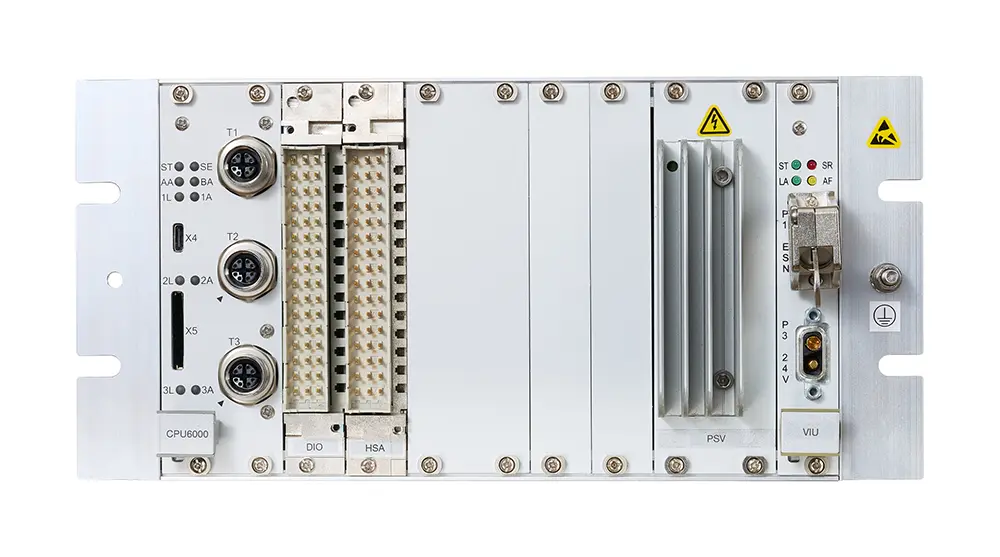
The ASDO system usually consists of two Central Processing Units (CPU), I/O modules, power supplies and a rack. Click on an image to explore related content.

Modular Concept

Below is an example of an ASDO system made up of a selection of common modules. The modules are the minimum required for ASDO, with additional modules available for expanded functionality. For example, HABD is often integrated within the same system. Hover over each area to view a brief description or click to access the full module page.

1

CPU with Graphical Display Controller (CPG) 

Supports DVI and Ethernet display interfaces

2

Power Supply Unit for VME (PSV)

Provides power for the ASDO HMI

3

Vehicle Identification Unit (VIU)

Required for door identification for the HMI.

4

CPU with Serial Links (CPS)

A central processing unit providing serial communication interfaces.

5

Digital Input Output Module (DIO)

A Digital Input Output Module for delivering digital ASDO signals to the ASDO CPU modules.

6

High Speed Analogue Input Module (HSA)

Converts analogue signals and makes them available to the ASDO CPU modules.

7

Power Supply Unit for VME (PSV)

A second power supply unit required to power the ASDO system

8

Vehicle Identification Unit (VIU)

A second VIU required for door identification for the ASDO System

Application Software

The ASDO application software is built on an open-source Linux platform and is coded in C and C++.

Unlike our TCMS platform, which allows users to code their own applications, ASDO application software is built by EKE-Electronics. This protects the SIL 2 certification which requires tools, processes and knowledge about how to produce SIL Safety applications.

ASDO Configurations

EKE-Electronics’ ASDO system offers a range of optional features to enhance safety, positioning accuracy, and integration flexibility. All options comply with SIL 2 safety standards and are designed for seamless integration with TCMS.

RFID Beacons

Purpose: Provides platform identification and positioning data using RFID technology.

  • RFID beacons installed before platforms deliver data on platform ID, length, side, and train direction.
  • ASDO validates beacon data against the Station Database and ESN configuration.
  • SIL 2 certified data source for enhanced safety.
  • Flexible installation: one or two readers per train unit, positioned at cab ends or mid-unit.
  • No additional ASDO hardware required for later integration.
ETCS Eurobalises

Purpose: Enables ASDO to use ETCS Packet 44 data for platform identification.

  • Balises installed before platforms provide platform ID, length, and train direction.
  • ASDO prioritises ETCS Packet 44 data over RFID beacon data.
  • SIL 2 compliance when using TRDP and SDTv2 protocols.
  • No extra ASDO hardware needed for future ETCS integration.
Position on Platform

Purpose: Determines the exact train position for safe door operation.

  • Combines RFID beacon data with platform dimensions stored in ASDO database.
  • Accuracy: ±1.0 m depending on speed and beacon placement.
  • Enables CSDE for correct side door opening.
TRDP and SDTV2 Protocols

Purpose: Ensures safe communication between ASDO and train systems.

  • TRDP and SDTv2 protocols are available on the EKE platform with the required interfaces.
Step Control

Purpose: Configures sliding step patterns for each station.

  • Displays step patterns on ASDO HMI alongside door patterns.
  • Sends enabling signals to TCMS for step control (not a safety function).
Multiple Stopping Points on Platform

Purpose: Allows trains to align doors at multiple platform points.

  • Configurable in Station Database for different train compositions.
  • Supports PRM (persons with reduced mobility) door alignment and flexible stopping strategies.
Why Choose EKE-Electronics for your ASDO?

EKE-Electronics combines decades of rail expertise with proven ASDO technology, delivering reliable, safety-certified solutions for operators worldwide. Our systems are designed for flexibility, fast deployment, and future upgrades, ensuring long-term value across diverse rail networks.

Over 2000 ASDO installations worldwide

With over 2,000 ASDO installations worldwide, EKE-Electronics offers a proven solution trusted by rail operators for safety, reliability, and flexibility. Our global experience ensures consistent performance for new builds and refurbishments projects.

Proven expertise in SIL Safety Applications
Our teams apply extensive experience when developing safety‑related systems for rail applications. They use processes aligned with EN 50126, EN 50129, and EN 50716 to guide each project stage. These processes support structured design, verification, and validation.
Future-ready architecture for fast deployment
EKE‑Electronics’ ASDO uses a modular architecture that supports fast deployment and easy upgrades. The design allows operators to add ETCS Eurobalises or RFID beacons when their networks require new positioning data. This approach lets fleets adapt to future needs without replacing the existing ASDO system.
Download Brochures
EKE-Trainnet® SIL Safety Applications

Frequently Asked Questions

ASDO stands for Automatic Selective Door Operation.

It is a train door control system that automatically controls train doors at each station stop by checking train location and platform configuration to ensure only safe doors open, improving passenger safety and comfort

Automatic Selective Door Operation (ASDO) is a train door control system that automatically controls train doors at each station stop by checking train location and platform configuration to ensure only safe doors open, improving passenger safety and comfort.

Go to the ASDO page to learn more

The Automatic Selective Door Operation system begins by verifying the platform configuration to ensure that doors open only at the correct locations. It uses odometry, in conjunction with GNSS and data from the ASDO Station Database, to locate the train and identify the station. This information determines the number of doors to open and on which side(s) of the train. If necessary, balises or beacons can also be utilised.

Go to the ASDO page to learn more

The ASDO Station Database contains essential infrastructure details like stations and platforms. This database builds the “station network” for Automatic Selective Door Operation usage and can be easily updated by operators to reflect changes such as track renewals, new routes, or stopping patterns.

Go to the ASDO page to learn more

Selective Door Operation allows the crew to manually select the doors that can be safely opened.

Go to the ASDO page to learn more

Correct Side Door Enabling is a train door control system that ensures that train doors open on the correct side of the train at each station platform. This is important for passenger safety and comfort, as passengers need to be able to easily access the train without having to cross over the tracks.

Go to the ASDO page to learn more

We offer multiple Automatic Selective Door Operation options to address diverse needs.

  • Odometry with GNSS,
  • Balises/beacons and
  • Odometry.


This flexibility allows us to adapt to various operational scenarios, recognising our customers’ unique preferences and constraints.

Go to the ASDO page to learn more

SIL or Safety Integrity Levels are defined levels of risk reduction applied to safety-related systems. They are designed to automatically prevent dangerous failures or to control them when they occur. SIL levels range from SIL 1 to SIL 4, with SIL 4 providing the highest level of risk reduction.

For more information, read our blog about implementing SIL for train products.

Safety Integrity Level (SIL) is a measure of the reliability and risk reduction capability of safety-related systems. For railway applications, SIL levels are defined by standards such as IEC 61508 and EN 50126/EN 50128/EN 50129.

Read more about Safety Integrity Levels

Packet 44 or P44 is a data packet used within the ETCS framework to convey information related to the position of trains. The primary purpose of P44 is to ensure that trains receive timely and precise location data, which is essential for maintaining safe distances between trains and thus preventing collisions.

For more in depth analysis read our blog.

Find out how we can work together